Washington, D.C. — April 14, 1865. The final curtain fell on the life of Abraham Lincoln not in the chamber of Congress, nor at a battlefield tent, but at Ford’s Theatre, under the flicker of stage gaslights. Shot by an assassin just days after the end of America’s Civil War, Lincoln’s death etched him into the bedrock of national mythology — not merely as a president, but as a redeemer.
Yet the story of Abraham Lincoln is far more than a tragic end. It is a tale of improbable ascent — from log cabin to White House — and of transformation, both personal and national. A man of deep introspection, rhetorical grace, and moral wrestling, Lincoln steered the republic through its most existential trial, preserving the Union and forever redefining its meaning.
Humble Origins and the Making of a Mind
Born February 12, 1809, in a one-room cabin in Kentucky, Lincoln’s early life was marked by frontier hardship. His mother died when he was nine, and his father, a stern carpenter, offered little emotional warmth. Yet Lincoln found escape and expansion through books — the King James Bible, Shakespeare, Euclid. With fewer than a year of formal schooling, he educated himself by firelight, developing a keen intellect and an eloquence that would one day command global attention.
His early years as a flatboat worker, store clerk, and self-taught lawyer in Illinois molded a man both practical and philosophical. He bore the air of a backwoods mystic — quiet, curious, with a wry humor and melancholic eyes.
Politics and Principle: The Rise of the Railsplitter
Lincoln’s political career began modestly in the Illinois state legislature, where he gained a reputation as a persuasive speaker and an astute strategist. He served a single term in Congress, opposing the Mexican-American War and slavery’s expansion — positions that made him a moral outlier in a nation increasingly polarized.
The passage of the Kansas-Nebraska Act in 1854, which allowed territories to decide the slavery question for themselves, reignited Lincoln’s political fire. He viewed slavery not just as a moral wrong, but as a threat to the republic’s founding ideals. His debates with Stephen A. Douglas during the 1858 Illinois Senate race catapulted him to national fame. Though he lost that election, his clarity, logic, and moral gravity marked him as a leader for the looming storm.
The Presidency and the War That Redefined America
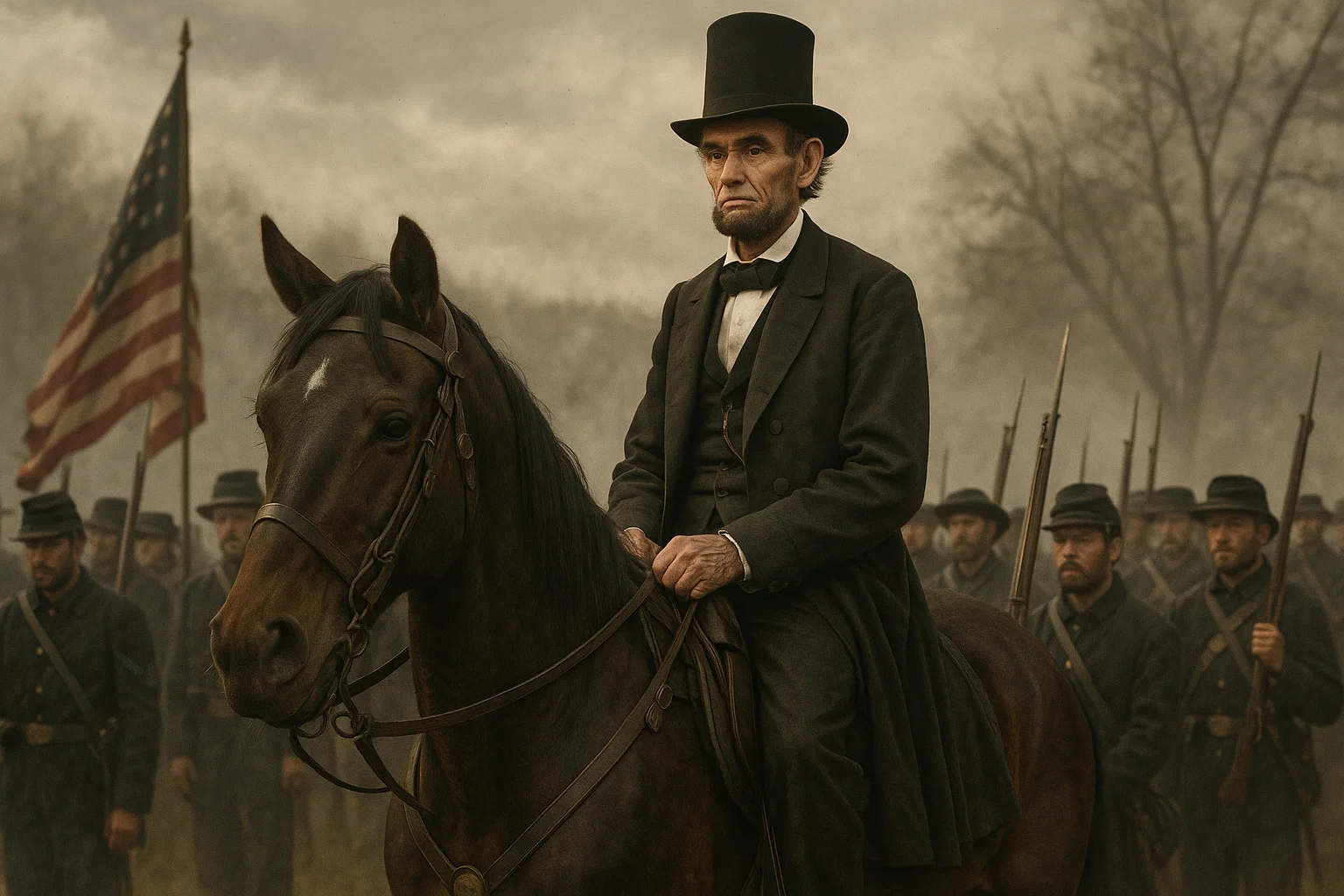
Lincoln entered the White House in March 1861 as the nation fractured. Within weeks, the Confederacy had seceded, and Fort Sumter was under attack. A war of preservation became, slowly but unmistakably, a war of transformation.
He led not as a conqueror but as a careful moral navigator. Lincoln faced not only Confederate armies, but radical Republicans, mutinous generals, and an impatient public. He read military manuals by night and shuffled through endless war reports by day.
In 1862, as battlefield carnage mounted, Lincoln issued the Emancipation Proclamation — a political gamble that redefined the war’s purpose. Slavery, once a tolerated stain on the Constitution, was now a moral line in the sand. Lincoln had tethered Union victory to human liberty.
He evolved with the times. Once cautious about abolition, he grew bolder, clearer. “As the case stands,” he said, “I am not bound to win, but I am bound to be true.”
Words That Reshaped the American Soul
Lincoln’s genius lay not only in policy but in prose. He spoke to the conscience of the nation with unmatched clarity:
-
The Gettysburg Address (1863): Just 272 words, yet it redefined American identity — “a new birth of freedom” — and elevated the sacrifices of the fallen into a sacred purpose.
-
Second Inaugural Address (1865): With victory in hand, Lincoln did not gloat. “With malice toward none; with charity for all,” he called for reconciliation, threading divine justice with human humility.
Lincoln understood that wars might win peace, but words would win the future.
Personal Shadows: Melancholy, Marriage, and Mortality
Behind the public stoicism was a man haunted by grief. The deaths of two sons — Eddie in 1850 and Willie in 1862 — cast long shadows over Lincoln’s heart. He battled chronic depression, which he masked with humor, stories, and long solitary walks.
His marriage to Mary Todd Lincoln, a socially ambitious woman from a slaveholding Kentucky family, was fraught. Her mental instability and extravagant spending were sources of stress, but Lincoln remained committed, often protective.
He found solace in Shakespeare’s tragedies, in poetry, and in silence. “To ease his mind,” one aide recalled, “he would read aloud the soliloquy of Hamlet.”
Leadership Style: Empathy, Logic, and Strategic Delay
Lincoln was a master of political timing. He waited, often frustratingly so, for moments when the moral and political could align. His cabinet — famously a “team of rivals” — included those who had once opposed him, like William Seward and Salmon Chase. Lincoln welcomed dissent, honed arguments, and arrived at decisions through deep thought and quiet confidence.
Unlike the autocrats of his day, Lincoln led through moral clarity, not coercion. He blended lawyerly reasoning with philosophical depth. He listened more than he spoke, then wrote with a surgeon’s precision.
Legacy: The Martyr President and the American Idea
On April 9, 1865, the Confederacy surrendered. Five days later, Lincoln was killed by John Wilkes Booth. His death canonized him, but his legacy endures in the questions he dared to ask: What is equality? What is liberty? What does it mean to be an American?
The 13th Amendment, which abolished slavery, bears Lincoln’s fingerprints. The Union he preserved now had a moral core. The Constitution was reborn not just as a legal document, but as a promise.
In monuments, speeches, currency, and conscience, Lincoln remains — a man of sorrows, a prophet in a stovepipe hat, a president who gave his life to hold the nation’s soul together.
Final Reflection
Abraham Lincoln did not seek greatness, but when history demanded it, he rose. He held together a breaking nation with humor, humility, and unshakable resolve. His genius was not just in leading a war, but in redefining the cause for which it was fought.
Where others saw expedience, he saw enduring principles. Where others chose vengeance, he chose reconciliation. In a fractured world, Lincoln’s legacy reminds us that courage, conscience, and character still matter.
He was, in the words of his friend Edwin Stanton at his deathbed, “belonged to the ages.”