
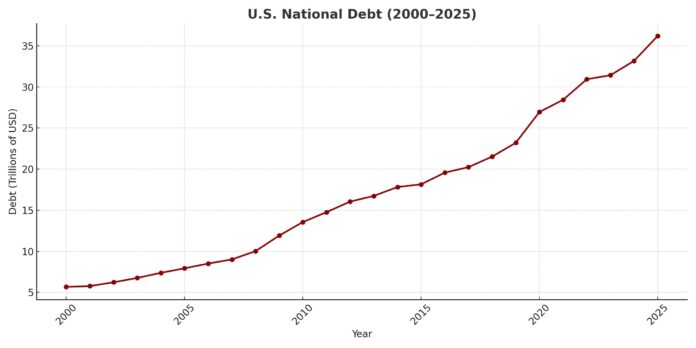
🕰️ Two decades ago, America’s national debt was a headline—but not a five-alarm fire. In the year 2000, it hovered just under $6 trillion. Fast forward to today, and the U.S. is hurtling toward a fiscal cliff: over $36.9 trillion in red ink and counting, rising by tens of thousands of dollars every second.
Visit USDebtClock.org, and it’s like watching a Vegas slot machine—but one where the house always loses.
🇺🇸 Every Citizen Now Carries Six-Figure Debt
The numbers are staggering. Divided evenly, the federal debt comes out to:
-
$108,000+ per U.S. citizen
-
$280,000+ per taxpayer
This isn’t Monopoly money—it’s real, and it’s climbing faster than inflation, wages, or even GDP. And the real kicker? That number doesn’t even include the trillions in unfunded liabilities—promises made but not backed by dollars.
🔥 How Did We Get Here?
It’s not one administration or one event—it’s decades of overspending and under-saving. But the last five years have thrown fuel on the fire.
Here’s the breakdown:
-
COVID-era stimulus flooded trillions into the economy.
-
Interest rates surged, making debt far more expensive to service.
-
Entitlement spending—Medicare, Medicaid, Social Security—keeps ballooning with an aging population.
-
Tax revenues are up, but not nearly enough to match outlays.
We now pay over $1 trillion annually in interest alone—just to keep the lights on.
🧩 The Debt Breakdown: Where Does It All Go?
According to the real-time data from the U.S. Debt Clock, the biggest slices of the federal spending pie in 2025 include:
| Spending Category | Estimated Annual Cost |
|---|---|
| Medicare & Medicaid | $1.6 trillion+ |
| Social Security | $1.4 trillion+ |
| Defense & War | $890 billion+ |
| Interest on National Debt | $684 billion+ (rising fast) |
| Federal Pensions | $323 billion+ |
| Welfare Programs | $570 billion+ |
And beyond the debt itself, unfunded liabilities—the promises made to future retirees and healthcare recipients—now total more than $200 trillion. That’s the real iceberg under the waterline.
📉 Debt-to-GDP: A Warning Sign in Red
The Debt-to-GDP ratio—once a canary in the coal mine—has now flown past 130%, putting America in league with heavily indebted nations like Japan. Why does this matter? Because when debt exceeds the size of the entire economy, it signals to creditors and investors that the U.S. might not always be able to pay its bills without printing money or raising taxes.
That trajectory has set off alarm bells on Wall Street and in Silicon Valley, where long-term stability is a prerequisite for investment. Elon Musk, the Tesla and SpaceX CEO took to X (formerly Twitter) to torch Donald Trump’s latest legislative achievement, a sweeping package dubbed the “Big Beautiful Bill.” Musk called it a “disgusting abomination,” warning that the bill will only accelerate America’s march toward financial ruin.
“This massive, outrageous, pork-filled Congressional spending bill is a disgusting abomination,” Musk posted. “Shame on those who voted for it — you know you did wrong.”
Musk’s rare political broadside isn’t just partisan posturing — it reflects growing alarm across the business and investor class. America’s borrowing binge has now pushed interest payments beyond $1 trillion per year, making debt service alone the third-largest line item in the federal budget after Social Security and Medicare.
🧠 What It Means for You
Even if you’re not glued to CNBC, this matters. A growing national debt puts pressure on interest rates, raises the specter of inflation, and forces the government to prioritize debt service over social services.
That could mean:
-
📈 Higher mortgage, car loan, and credit card rates
-
🍞 More inflation on everyday goods
-
✂️ Cuts to future Medicare, education, or infrastructure funding
-
💸 Higher taxes to plug the gap
🗳️ Can It Be Fixed?
Technically? Yes.
Politically? That’s another story.
Solutions are available: raise taxes, cut spending, restructure entitlements, or turbocharge GDP growth. But every option carries major political risk—and Washington is notoriously short on appetite for hard decisions.
Both parties talk a big game, but neither has presented a credible long-term roadmap.
📌 Final Word
The U.S. national debt isn’t just an economic footnote—it’s the economic story of our generation. It tells a tale of ambition, excess, emergencies, and avoidance. And unless leaders act decisively—and soon—the next generation of Americans will inherit not just the debt, but the consequences.
So the next time you see that spinning green ticker at USDebtClock.org, remember: it’s not just a number.
It’s our future.